Creating a Dopamine Menu: A Psychiatric and DBT-Informed Approach
Creating a Dopamine Menu: A Psychiatric and DBT-Informed Approach
Good mental health treatment often involves learning how to recognize what is happening internally before emotions become overwhelming. For individuals navigating conditions such as Borderline Personality Disorder (BPD), Complex PTSD (C-PTSD), PTSD, bipolar disorder, ADHD, depression, anxiety, and other emotional regulation challenges, having practical tools to help you learn more about your emotional needs and give you some quick, helpful coping strategies can make a meaningful difference can be really powerful. In Dialectical Behavior Therapy (DBT), one of the foundational skills used to support emotional regulation and crisis management is the safety scale. This is a tool that we often use in DBT as a way of checking in with yourself, identifying your current level of distress, and matching your response to what you need at that moment. Even the act of making the safety skill is a useful exercise for learning more about your emotions and what kinds of coping skills you have in your toolbox, or what areas could use some extra coping skill options.
Recently, a newer concept called a “dopamine menu” has been trending on social media as a way to intentionally build a list of activities that provide healthy sources of motivation, pleasure, connection, grounding, and reward. While it comes from a different framework, the idea overlaps with many of the goals of DBT: increasing awareness, creating a plan before you are overwhelmed, and having accessible tools ready when your brain needs support. In today’s blog, we are exploring how these two ideas, the traditional DBT safety scale and the newer dopamine menu concept, can work together. By combining the structure of a safety scale with the personalized, positive approach of a dopamine menu, you can create a practical “toolkit” that helps you recognize where you are emotionally and choose strategies that support regulation, resilience, and overall well-being.
Understanding the “Dopamine Menu”
So first off, what is this new hot topic of a "dopamine menu"? Is this a snack menu where you eat your favorite cheetos and candy to replenish your dopamine supply? Nope, that isn’t really how it works. The idea of a “Dopamine Menu” is a personalized list of healthy, rewarding activities that can help improve mood, increase motivation, and reduce the urge to engage in unhelpful coping behaviors when you are feeling stressed, overwhelmed, bored, depressed, anxious, or emotionally dysregulated. The goal is not to "chase dopamine," but rather to intentionally engage in activities that support emotional regulation, behavioral activation, and overall well-being.
From a psychiatric perspective, symptoms of depression, ADHD, anxiety, trauma-related disorders, and burnout can all contribute to reduced motivation and difficulty initiating healthy behaviors. You may also find that when you feel very overwhelmed and your emotions are extra high, that picking healthy coping skills can be challenging. A dopamine menu as well as a safety scale can help reduce decision fatigue and provide a pre-planned list of coping strategies when your brain is struggling to generate ideas in the moment.
Here is an example of what a “Dopamine Menu” might look like. You can also work on building your own via this template or create your own. That could be a dopamine treat in itself by using your creativity to design your own.
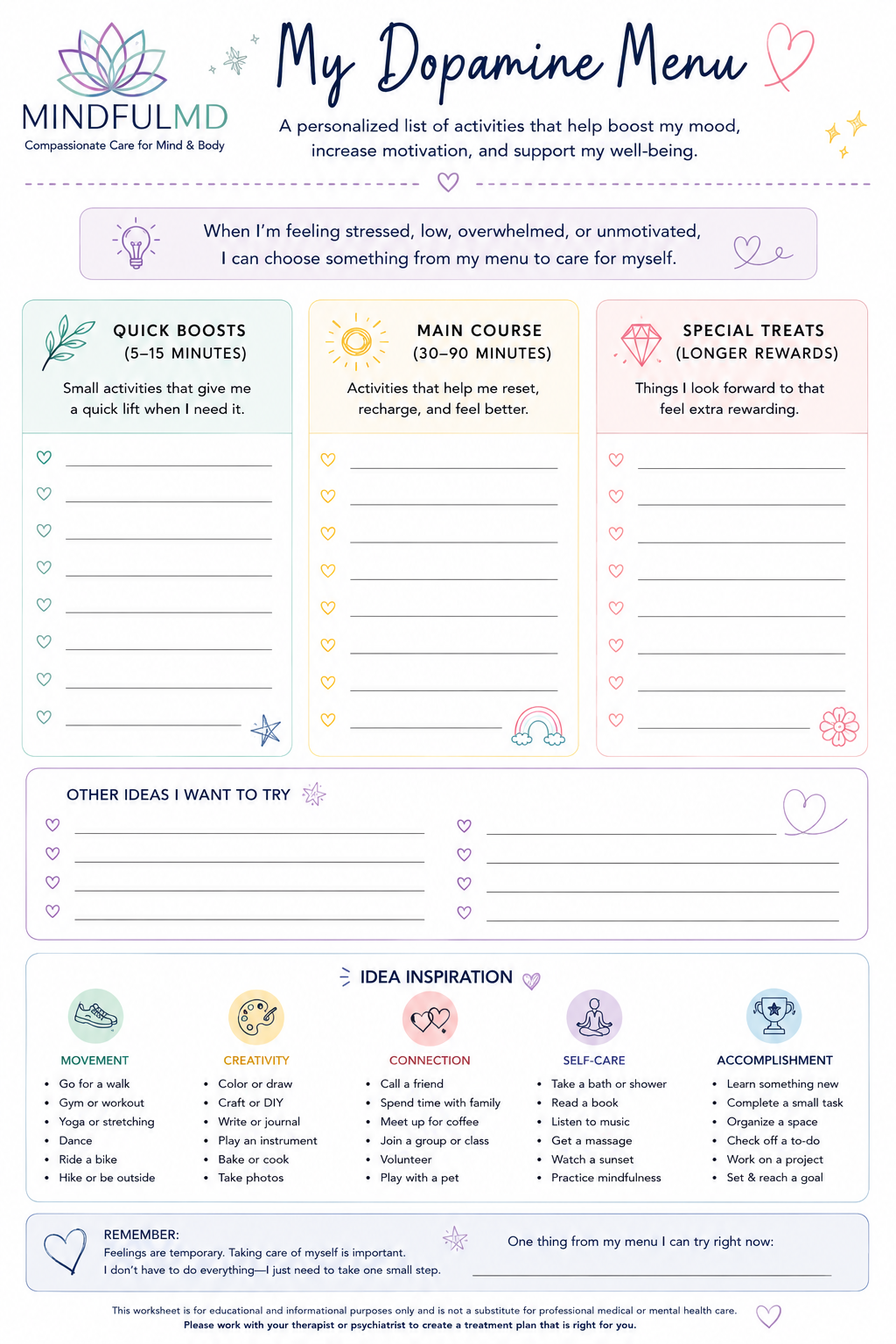
This is an educational example, not a substitute for professional medical or mental health care.
Building Your Personalized Dopamine Menu
When creating your dopamine menu, it is helpful to include options from a variety of categories rather than relying on just one type of activity. This is because different moments call for different types of support, what helps you when you are exhausted may not be the same thing that helps when you are anxious, lonely, overwhelmed, restless, or feeling emotionally numb. A well-rounded dopamine menu gives your brain multiple pathways to feel regulated, connected, motivated, or soothed depending on what you need at that moment.
Consider including activities from several categories:
Movement
Going to the gym
Walking outdoors
Dancing
Yoga
Swimming
Bike riding
Connection
Calling a friend
Meeting someone for coffee
Attending a club or group
Spending time with family
Relaxation and Self-Care
Booking a massage
Taking a bath
Reading
Listening to music
Spending time in nature
Mastery and Accomplishment
Completing a household task
Learning a new skill
Working on a hobby
Organizing a small area of your home
Completing a work project
Pleasure and Enjoyment
Listening to an audiobook
Watching a favorite movie
Cooking a favorite meal
Visiting a bookstore
Exploring a new place
The Goal of a “Dopamine Menu”
The purpose of a dopamine menu is to create intentional, healthy sources of reward that support emotional regulation and long-term mental health. When paired with a DBT distress scale or traffic light system, it can become a practical tool for recognizing when you need support and choosing an intervention that matches your current level of distress. Rather than waiting until you're overwhelmed, the goal is to notice early warning signs and use coping skills proactively, helping to prevent emotional escalation and promote resilience over time.
Understanding the Classic Safety Scale
So what about the classic safety scale tool often used in the DBT therapy as well as other evidence-based therapies to help individuals recognize their level of emotional distress, identify warning signs early, and choose coping skills that match their current needs? This is a tool that has been around for a long time and I’ve had numerous patients use a safety scale as both an activity to help them increase their own self-awareness of their emotional bandwidth and learn what coping strategies they may want to use to intervene before emotions become overwhelming or unsafe.
There are several ways to create a safety scale. Some people prefer the simple Green-Yellow-Red Light System, where green represents feeling stable and in control, yellow represents increasing distress or vulnerability, and red represents a crisis or situation requiring immediate support. Others prefer a 1–5 or 1–10 numerical scale, which allows for more precise tracking of emotional intensity and can help identify patterns over time. This is a person to person preference. No single format is "right" for everyone. Regardless of the format used, the purpose remains the same: to help you recognize how you're feeling, identify what level of support you need, and choose appropriate coping skills, DBT strategies, or support resources before a crisis develops. This is definitely something you can talk with your psychiatrist and therapist about to help you create your own personalized safety scale. Your therapist may have additional ideas on what coping strategies you can implement on your safety scale as well as helping you learn new coping skills to add to your toolbox of options.
When used consistently, safety scales can become a valuable part of a personalized coping plan, helping individuals respond proactively rather than reactively to emotional distress. We often will recommend that folks design one of these for themselves, and put it in locations where they can refer to it easily when they need it, such as on their fridge, a copy on their phone, or even a small print out the carry in their pocket/purse.
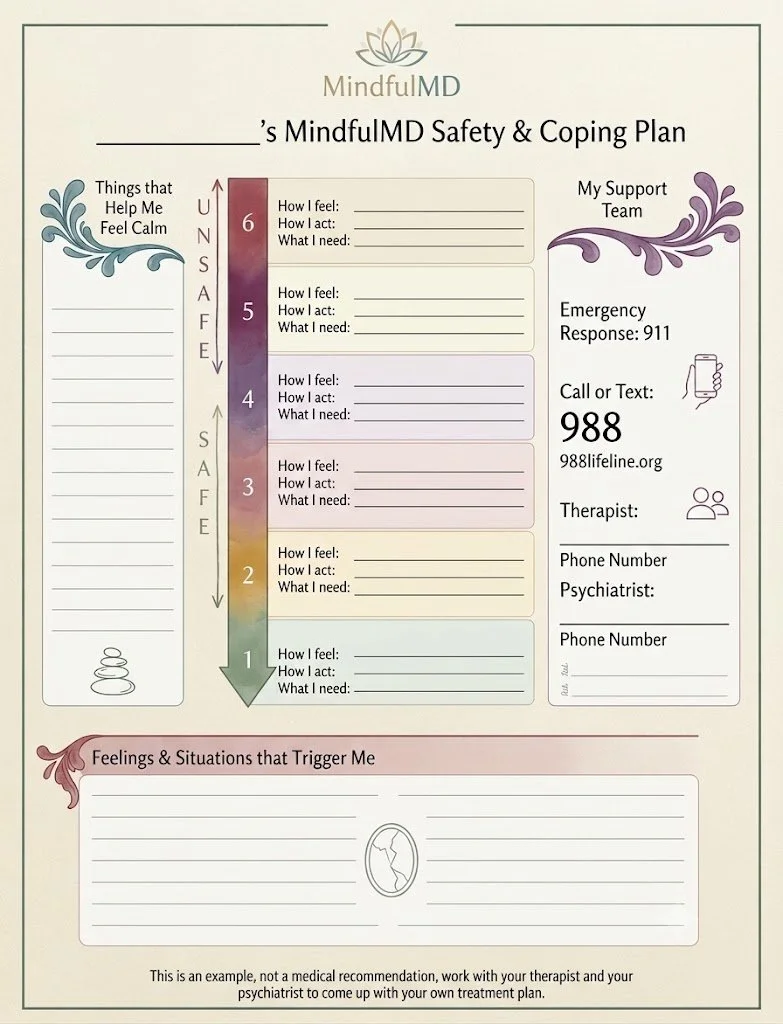
This is an educational example, not a substitute for professional medical or mental health care.
Pairing A Dopamine Menu with Your DBT Style Safety Plan
A fun new approach that can pair well alongside the traditional DBT Safety Plan is adding some extra options with a Dopamine Menu to give yourself an array of options to go along with your Safety Scale. When I think of a safety scale, I think of having a couple of solid options, but not too many where it gets overwhelming, just enough where in a moment of heightened emotion, you can know what your game plan is and you can go to it without too much thinking required. This is something to discuss with your doctor or therapist to help you come up with a game plan you can use when things start to get heightened. The Dopamine Menu option would often be used during times of less emotional distress as more of a preventative menu of ideas to help keep things stable, while the Safety Scale is a tool to help you cool things down when they start to ramp up, or when they are already ramped up and you need something to help remind you how to put out the fire in your mind.
Remember: the safety scale is a clinical tool commonly used in DBT to help individuals quickly identify their current level of emotional distress and match it with an appropriate level of support. It is designed to be structured, safety-focused, and practical, especially during times of emotional escalation, crisis, or reduced ability to think clearly. In contrast, the dopamine menu is a more flexible and creative supplemental tool that can be incorporated into day-to-day life to intentionally support motivation, pleasure, grounding, and emotional regulation through a variety of personalized activities. While the dopamine menu can be helpful for building resilience and expanding coping options, it does not replace the safety scale. In moments of significant distress, dysregulation, or safety concerns, the safety scale remains a useful tool to help guide decision-making when emotions are heightened and help someone recall their resources when they may need to seek support or get urgent help.
Important Disclaimer
These worksheets are intended for educational purposes only and are not a substitute for medical, psychiatric, or psychological treatment. While social media, podcasts, books, websites, and online communities can provide helpful ideas and support, they should not be considered personalized medical advice. Information found on the internet is often generalized, may not apply to your unique situation, and can sometimes be inaccurate or misleading.
The activities, coping skills, and examples included in this worksheet are provided as suggestions only and should not be interpreted as specific treatment recommendations. Mental health treatment should be individualized based on your symptoms, medical history, goals, and personal circumstances. You should work closely with your therapist, psychiatrist, or other qualified healthcare professional to develop a treatment plan that is tailored to your needs. If you have questions about whether a particular coping strategy, lifestyle change, supplement, or treatment approach is appropriate for you, please discuss it with your healthcare provider before making changes to your treatment plan.